Scoring 8.0 in IELTS Academic: What It Means for Nigerians Targeting Germany and Europe
An overall band score of 8.0 in IELTS Academic places a candidate within the top tier of test takers globally. It is not a common result. According to IELTS data, fewer than 5% of all test takers achieve a band 8 or above overall. For a Nigerian candidate planning to study or work in Germany or across the European Union, this score carries specific, measurable advantages — and understanding what those advantages are, precisely, matters more than the prestige of the number itself.
This article breaks down what an 8.0 score means in practice, where it creates real leverage in the German and EU admissions landscape, and how to think strategically about retaking the test if your score falls short of your goals.
Score Breakdown and What It Means
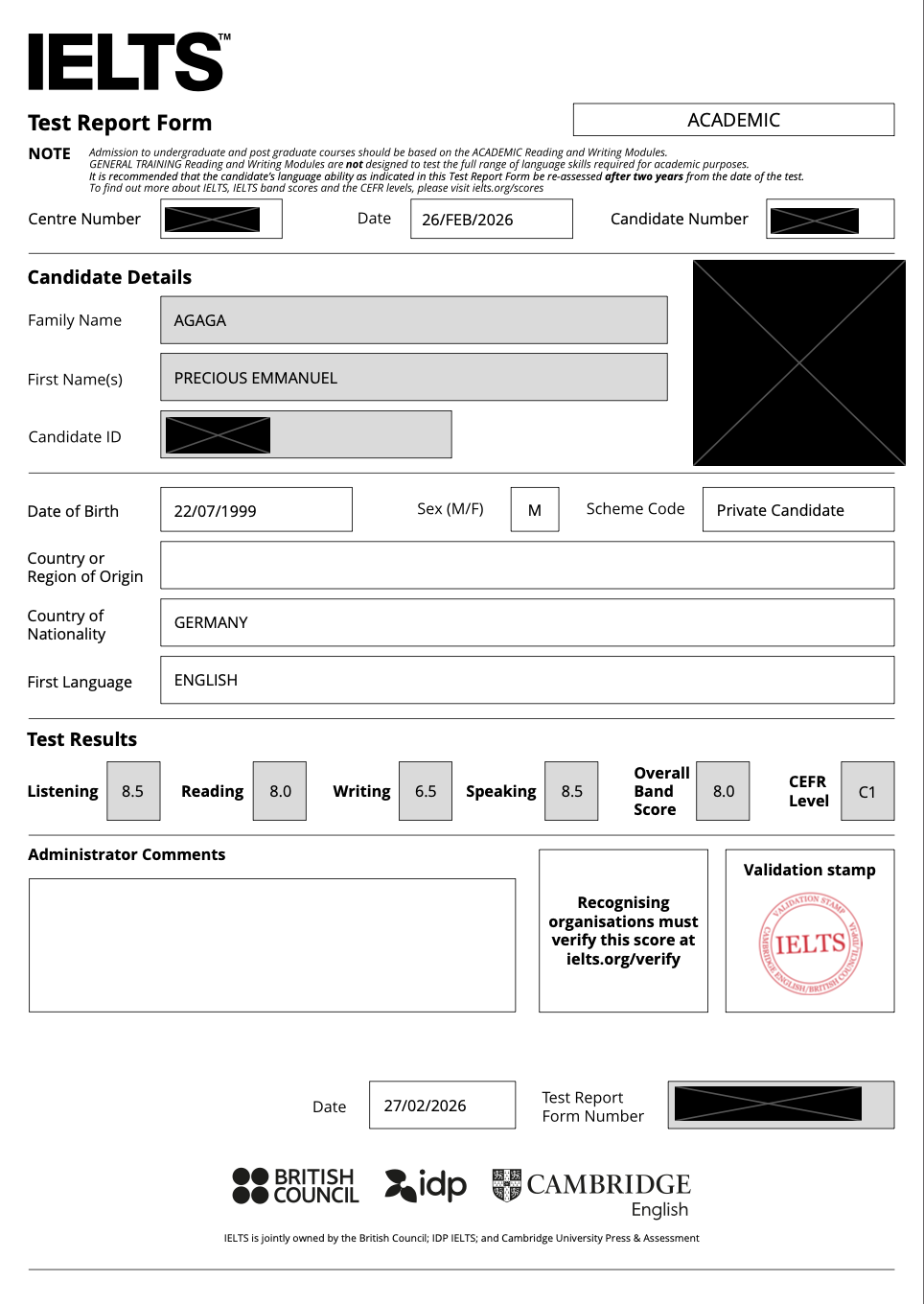
The following result is used as the basis for this analysis:
| Component | Band Score | CEFR Level |
|---|---|---|
| Listening | 8.5 | C1/C2 |
| Reading | 8.0 | C1 |
| Writing | 6.5 | B2 |
| Speaking | 8.5 | C1/C2 |
| Overall | 8.0 | C1 |
Test taken: February 2026
The overall band score of 8.0 corresponds to CEFR level C1 — described by the Common European Framework as “effective operational proficiency.” At this level, a candidate can understand a wide range of demanding texts, express ideas fluently, and use language flexibly and effectively for academic and professional purposes.
The profile above is worth examining carefully. Listening and Speaking at 8.5 indicate near-native receptive and oral fluency. Reading at 8.0 is consistent with strong academic comprehension. Writing at 6.5, while still above many admission thresholds, is notably lower than the other components — a pattern common among strong English speakers, and one that has strategic implications discussed below.
Is 8.0 Necessary for Germany?
For most German university programmes taught in English, an 8.0 overall band is not a stated requirement. The typical IELTS thresholds for English-medium programmes in Germany are:
- 6.0 – 6.5: Standard requirement for most Bachelor’s and Master’s programmes
- 6.5 – 7.0: Common for competitive programmes at TU Munich, LMU, Heidelberg, and similar institutions
- 7.0+: Required by select highly ranked or internationally competitive programmes
This means that if your goal is admission to an English-taught Master’s programme at a German university, an overall 6.5 is usually sufficient. An 8.0 does not increase your chances of admission at institutions where 6.5 is the stated minimum — admissions committees do not weight higher IELTS scores beyond the threshold unless English proficiency is itself a selection criterion.
Where an 8.0 score does matter is in a specific set of competitive contexts, outlined below.
Where 8.0 Makes a Difference
DAAD Scholarships
The German Academic Exchange Service (DAAD) funds some of the most competitive international scholarships available to Nigerian students. Programmes such as the DAAD Development-Related Postgraduate Courses (EPOS) and the Helmut Schmidt Programme for public policy candidates are assessed holistically, but English proficiency at a demonstrably high level strengthens a profile. An 8.0 with strong Listening and Speaking scores signals a candidate who can function at full academic capacity in an English-medium environment from day one — something that matters when DAAD panels review hundreds of applications from across the African continent.
Highly Selective Master’s Programmes
Some Master’s programmes in Germany — particularly in Economics, Computer Science, and Public Policy — are structured as international cohorts with explicit expectations around seminar participation, peer critique, and written output. These programmes may not publish a formal IELTS cut-off above 7.0, but they are populated by candidates with profiles in the 7.5–8.0 range. An 8.0 overall is competitive at this level.
Applying Across Multiple EU Countries Simultaneously
A Nigerian candidate applying to Germany, the Netherlands, Sweden, and Denmark simultaneously — a common and sensible strategy — will encounter varying IELTS requirements across those systems. Dutch research universities (particularly Delft, Amsterdam, and Utrecht) often list 7.0 as a minimum for competitive programmes. In Sweden, Lund and KTH regularly see successful applicants with 7.5+. An 8.0 score is universally above threshold across EU English-medium programmes, removing English proficiency as a variable in any multi-country application strategy.
English-Based Skilled Migration Pathways
Germany’s Chancenkarte (Opportunity Card) system, introduced under the Skilled Immigration Act, is a points-based pathway that does not require a job offer. English language proficiency contributes to the points calculation. While German language skills are weighted more heavily in the Chancenkarte scoring matrix, a demonstrable high-level English certification is an asset in roles where English is the working language — particularly in international technology, finance, and research sectors within Germany.
Writing Score Reality Check
The Writing band of 6.5 in the result above is the most instructive data point in the profile. This gap — between 6.5 in Writing and 8.0–8.5 in the receptive and oral skills — is not unusual. It reflects a structural feature of IELTS Academic Writing assessment rather than a fundamental language deficiency.
IELTS Academic Writing is assessed on four criteria: Task Achievement, Coherence and Cohesion, Lexical Resource, and Grammatical Range and Accuracy. Strong English speakers often score lower than expected because:
- Task 1 requires a specific, learned skill — accurately summarising and interpreting visual data (graphs, charts, maps) in a formal register. This is not a naturally occurring skill; it must be practised explicitly.
- Task 2 requires structured argumentation with a clear position, developed paragraphs, and disciplined conclusion. Many capable writers produce responses that are content-rich but structurally inconsistent — which pulls down Coherence and Cohesion scores.
- IELTS examiners apply a strict band descriptor grid. A single error pattern repeated across a response can cap the Grammatical Range and Accuracy score at 6.5 or 7.0 regardless of overall fluency.
How to Move from 6.5 to 7.5 in Writing
- Practice Task 1 with past papers. Analyse the graph before writing. State an overview in the second paragraph, then describe key trends with supporting detail. Avoid speculation.
- For Task 2, practise a fixed essay structure: thesis statement in the introduction, two or three body paragraphs each with one controlling idea, a concise conclusion that restates the position without introducing new points.
- Use a range of sentence structures deliberately — compound-complex sentences, conditionals, passive constructions — and vary them. Relying on simple or compound sentences throughout limits the Grammatical Range score.
- Self-edit for word count: Task 2 responses under 260 words are penalised. Responses over 300 words that pad rather than develop ideas can weaken Task Achievement.
- Seek feedback from a trained IELTS examiner or use an IELTS Writing correction service to get band-level feedback on your actual responses. Generic grammar improvement will not move the Writing score efficiently.
Should Nigerians Aim for 7.0 or 8.0?
The right target depends entirely on your intended pathway, not on a generalised aspiration.
If your goal is a standard English-taught Master’s in Germany, a 6.5 overall — with no individual component below 6.0 — meets most institutional requirements. Spending additional months and money preparing for a higher band is not an efficient use of resources if the programmes you are applying to do not require it.
If you are targeting competitive programmes at institutions like TU Munich, RWTH Aachen, or Mannheim, or programmes that list 7.0 as a minimum, aim for a 7.0–7.5 overall with Writing at 6.5 or above. These are realistic targets with focused preparation.
If you are pursuing scholarship pathways — DAAD, Konrad-Adenauer-Stiftung, or Friedrich Ebert Stiftung — a 7.5 or above overall strengthens an application that will be evaluated against a competitive pool. In this context, a higher score has genuine strategic value.
If you are building a multi-country mobility strategy — applying to Germany, the Netherlands, Sweden, or Denmark simultaneously — an 8.0 overall is universally sufficient and removes language proficiency from consideration at virtually every English-medium institution in Western Europe. This is the context in which a score like the one analysed here produces the clearest strategic return.
Cost and Timeline in Nigeria
IELTS Academic is administered in Nigeria primarily through the British Council, with test centres in Lagos, Abuja, Port Harcourt, Ibadan, and Kano.
| Item | Details |
|---|---|
| Test fee (2026) | Approximately ₦155,000 – ₦175,000 (confirm current rate with British Council Nigeria) |
| Test format | Computer-delivered or paper-based |
| Results timeline | Computer-delivered: 3–5 business days. Paper-based: 13 calendar days |
| Score validity | 2 years from test date |
| Rescheduling / cancellation | Must be done at least 5 weeks before the test date to receive a partial refund |
| Score reports | Five free Additional Test Report Forms (TRFs) per sitting; additional reports carry a fee |
British Council Nigeria provides online booking. Registration periods for popular test dates fill quickly, particularly in Q1 and Q4. Candidates planning to apply to German universities for winter semester intake (application windows typically October–January) should sit the test no later than August of the application year to allow time for preparation, a potential resit, and result delivery.
Summary
An IELTS Academic score of 8.0 is a strong result by any measure. For Nigerians targeting Germany specifically, it exceeds the minimum threshold for virtually every English-taught programme and positions a candidate competitively for DAAD scholarships, selective Master’s programmes, and multi-country EU applications. The Writing score of 6.5 in the profile analysed here is the one component worth improving for candidates whose target programmes include scholarship competition or highly selective cohorts. Improving Writing from 6.5 to 7.5 requires structured, specific preparation — not general English improvement.
The strategic question for any Nigerian candidate is not whether 8.0 is impressive. It is whether the score you currently hold, or are preparing for, matches the specific requirements of the institutions and pathways you are actually pursuing.
Last updated: February 2026. Always confirm specific IELTS requirements directly with the university or embassy.
Comments
Loading comments…
Leave a comment
Thanks! Your comment has been submitted and will appear after review.