Scoring 8.0 in IELTS Academic: What It Means for Nigerians Targeting Germany and Europe
Band 8.0 overall puts you in a thin slice of test takers. IELTS publishes that fewer than 5% of people score 8 or higher across the board. Nice headline, but the real question is what that buys you in Germany or elsewhere in Europe, especially if you’re applying from Nigeria.
This post is my read on the score: what each part meant for me, where 8.0 actually moves the needle, and where people oversell it. I’m not an agent; I’m someone who needed the number for real plans.
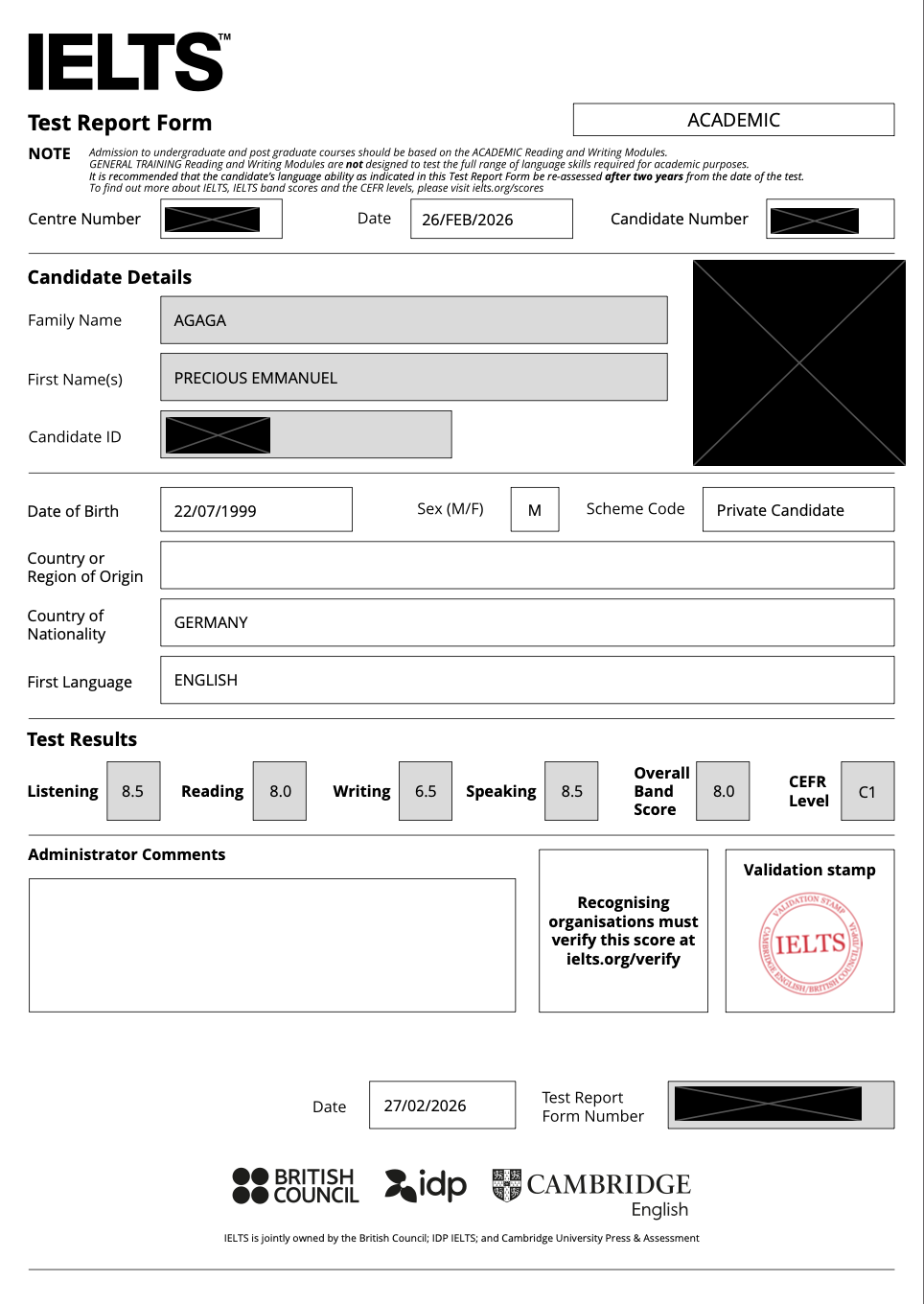
The breakdown I’m working from
| Component | Band Score | CEFR Level |
|---|---|---|
| Listening | 8.5 | C1/C2 |
| Reading | 8.0 | C1 |
| Writing | 6.5 | B2 |
| Speaking | 8.5 | C1/C2 |
| Overall | 8.0 | C1 |
Test date: February 2026
Overall 8.0 maps to C1 on the European scale: you’re supposed to handle demanding material and speak or write with flexibility. In practice my profile was lopsided: listening and speaking sat up at 8.5, reading was solid, and writing lagged at 6.5. That gap matters if you’re chasing scholarships or programmes that read every subscore.
Do you “need” 8.0 for Germany?
Usually, no. Most English-taught degrees ask for something in this ballpark:
- 6.0-6.5: typical floor for a lot of Bachelor’s and Master’s programmes
- 6.5-7.0: common at bigger-name schools (TU Munich, LMU, Heidelberg, and similar)
- 7.0+: shows up on pickier or very international programmes
So if your only goal is “get into an English Master’s in Germany,” a 6.5 overall often clears the bar. Admissions teams don’t hand out extra points for 8.0 when the minimum was 6.5. They check the box and move on.
Where 8.0 helps is narrower: scholarships, crowded programmes, and applications that span several countries at once. More on that below.
Where a high band actually helps
DAAD and similar scholarships
DAAD and other funders read the whole file, not just one line. Strong listening and speaking scores signal you can walk into seminars and hold your own on day one. That’s not the only thing they look at, but it can matter when they’re comparing hundreds of applicants from the same region.
Tight Master’s cohorts
Some programmes in economics, CS, or public policy fill with people who already sit in the 7.5-8.0 range even if the website only says 7.0. An 8.0 overall keeps English from being the thing that makes you look borderline next to that crowd.
Applying to several EU countries at once
If you’re sending the same application to Germany, the Netherlands, Sweden, and Denmark (lots of people do), each system has its own IELTS habit. Dutch research unis often want 7.0 on competitive courses; Swedish schools like Lund or KTH regularly see successful applicants north of 7.5. One 8.0 certificate means you’re not juggling different English floors in your head for each country.
Opportunity Card and English in work
Germany’s Chancenkarte is points-based; German usually weighs heavier than English, but a solid English cert still helps in international teams (tech, finance, research) where the working language isn’t German.
The writing score: the honest part
Writing at 6.5 while everything else sits at 8+ is a pattern I see a lot. It doesn’t mean you can’t write; it means IELTS Academic Writing scores how you follow their task rules, not how clever you sound.
Task 1 wants a specific skill: read a chart or diagram and summarise it in a fixed register. You learn that by practice, not by being fluent in English alone.
Task 2 wants a tight essay shape: clear position, paragraphs that each do one job, a conclusion that doesn’t introduce new ideas. “Strong opinions badly structured” still lands in the 6.x range.
If you’re trying to lift writing from 6.5 toward 7.5:
- Drill real Task 1 papers until the overview paragraph is automatic.
- Use a fixed essay skeleton for Task 2 and stick to it under time.
- Mix sentence types on purpose (conditionals, passive where it fits, one idea per paragraph).
- Stay inside word limits; too short gets penalised, padding hurts task achievement.
- Pay for feedback from someone who marks IELTS, not generic grammar fixes.
What should you aim for?
It depends on your lane, not on bragging rights.
English-taught Master’s in Germany, mid-tier requirements: 6.5 overall with no skill below 6.0 is often enough. Chasing 8.0 “just because” can be months and money you could put toward applications or experience.
Competitive programmes or 7.0 stated minimums: aim for 7.0-7.5 overall and try to get writing at least to 6.5 so nothing looks weak next to the rest.
Scholarships (DAAD, party foundations, etc.): 7.5+ overall makes you less easy to drop on language when the pool is tight. Here a higher band has real value.
Multi-country applications: 8.0 overall clears almost every English-medium bar in Western Europe in one go. That’s the case where the extra band pays off in simplicity.
Sitting the test in Nigeria (practical bits)
IELTS Academic runs through British Council Nigeria with centres in Lagos, Abuja, Port Harcourt, Ibadan, and Kano.
| Item | Details |
|---|---|
| Test fee (2026) | Roughly ₦155,000-₦175,000 (confirm with British Council before you book) |
| Format | Computer or paper |
| Results | Computer: often 3-5 working days. Paper: about 13 calendar days |
| Validity | 2 years from test date |
| Reschedule / cancel | Usually need 5+ weeks before test day for a partial refund |
| Score reports | Five free TRFs per sitting; extra copies cost extra |
Book early for busy windows (often Q1 and Q4). If you’re aiming for winter intake in Germany, sit the test with enough runway for a possible retake and for unis to receive scores.
Bottom line
8.0 is a strong score. For Germany specifically it clears almost every English-taught programme minimum and helps in scholarships and multi-country strategies. The weak spot in my own result was writing at 6.5; if you’re chasing the most selective funding or cohorts, that’s the piece I’d train next, not “general English.”
The useful question isn’t whether 8.0 sounds impressive. It’s whether your target programmes and scholarships care about margins above their stated floor, and whether your weakest band matches what they stress.
Last updated: February 2026. Always confirm IELTS rules with each university or embassy; they change.
Comments
Loading comments…
Leave a comment
Thanks! Your comment has been submitted and will appear after review.